- 1929 (MCMXXIX)
- 2020 (MMXX)
- Indian
- Freelance (costume design)
- •First Indian Oscar winner (Best Costume Design, Gandhi, 1983)
- •Forty years of Hindi cinema costume
- •Guide (1965)
- •Lagaan (2001)
Bhanu Athaiya
The Kolhapur miniature-painter who, in 1983, became the first Indian to win an Academy Award, and who dressed four decades of Indian cinema.
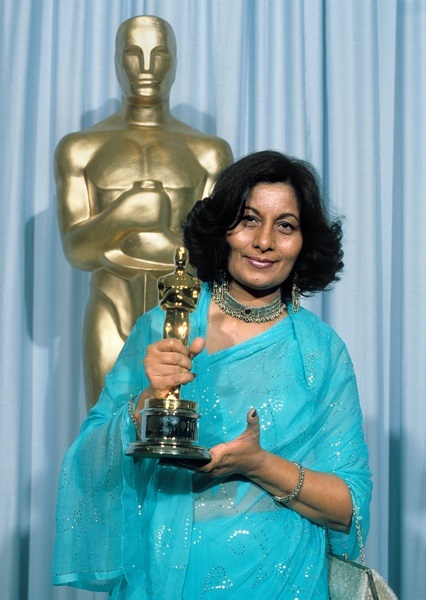
Bhanu Athaiya's Academy Award for Gandhi in 1983 was the first won by any Indian in any category. She shared the award with the English designer John Mollo; her contribution was the research and execution of the Indian costume across the film's forty-year time span — from Gandhi's Edwardian South African lawyer phase, through the khadi-loincloth years, to the assassinated white-robed elder of 1948.
She was born Bhanumati Annasaheb Rajopadhye in 1929 in Kolhapur, Maharashtra, to a family of traditional Rajopadhye Brahmin scholars. She trained as a painter at the Sir J.J. School of Art in Bombay, where she was the only woman in her class, and exhibited in 1951 at the first Progressive Artists' Group show alongside F. N. Souza, M. F. Husain, and S. H. Raza.
The Transition to Cinema
Athaiya entered cinema in 1956 almost accidentally: a neighbour, the producer Nargis, needed costume designs for Chori Chori and asked her to contribute. She sketched overnight. The credit appeared; further commissions followed. By 1970 she was the industry's only costumier with an extensive textile-research practice.
The Career Arc
Her filmography spans more than a hundred feature films across four decades. Her principal collaborators were Raj Kapoor, Guru Dutt, Vijay Anand (Guide, 1965, for which she designed Waheeda Rehman's dance costumes), Yash Chopra (Silsila), and Ashutosh Gowariker (Lagaan, 2001). The wardrobes she designed for Guide are the most-studied single costume run in Hindi cinema.
Fabric has memory. The memory is why we wear it. Without memory, it is merely cloth. — Bhanu Athaiya
The Gandhi Research
Athaiya's research for Gandhi was conducted over thirteen months, primarily at the National Archives, the Sabarmati Ashram in Ahmedabad, and the Gandhi Memorial Museum in Delhi. She commissioned hand-loom khadi from two separate Gujarat weavers to obtain the correct warp-and-weft for the later-period garments. Richard Attenborough, in his memoir, credited her with ensuring the film's costume read as credible to Indian audiences.
The Oscar
Athaiya's Oscar was the largest single public event for Indian costume design in the twentieth century. She was photographed, at the 1983 ceremony, wearing a hand-loom ivory sari of her own design. Her fifteen-second acceptance speech is routinely replayed in Indian costume-design programmes. She died in Mumbai on 15 October 2020, at ninety-one. Her personal archive of 35,000 sketches and 2,000 film notebooks was donated in 2021 to the National Film Archive of India in Pune.
Related Dispatches

Mod: How British Teenagers Killed Parisian Fashion in the 1960s
Carnaby Street, the Vespa, a geometric mini, a bob cut to the jawline. The youth-culture uprising that, for the first time in fashion history, dictated the terms to Paris.
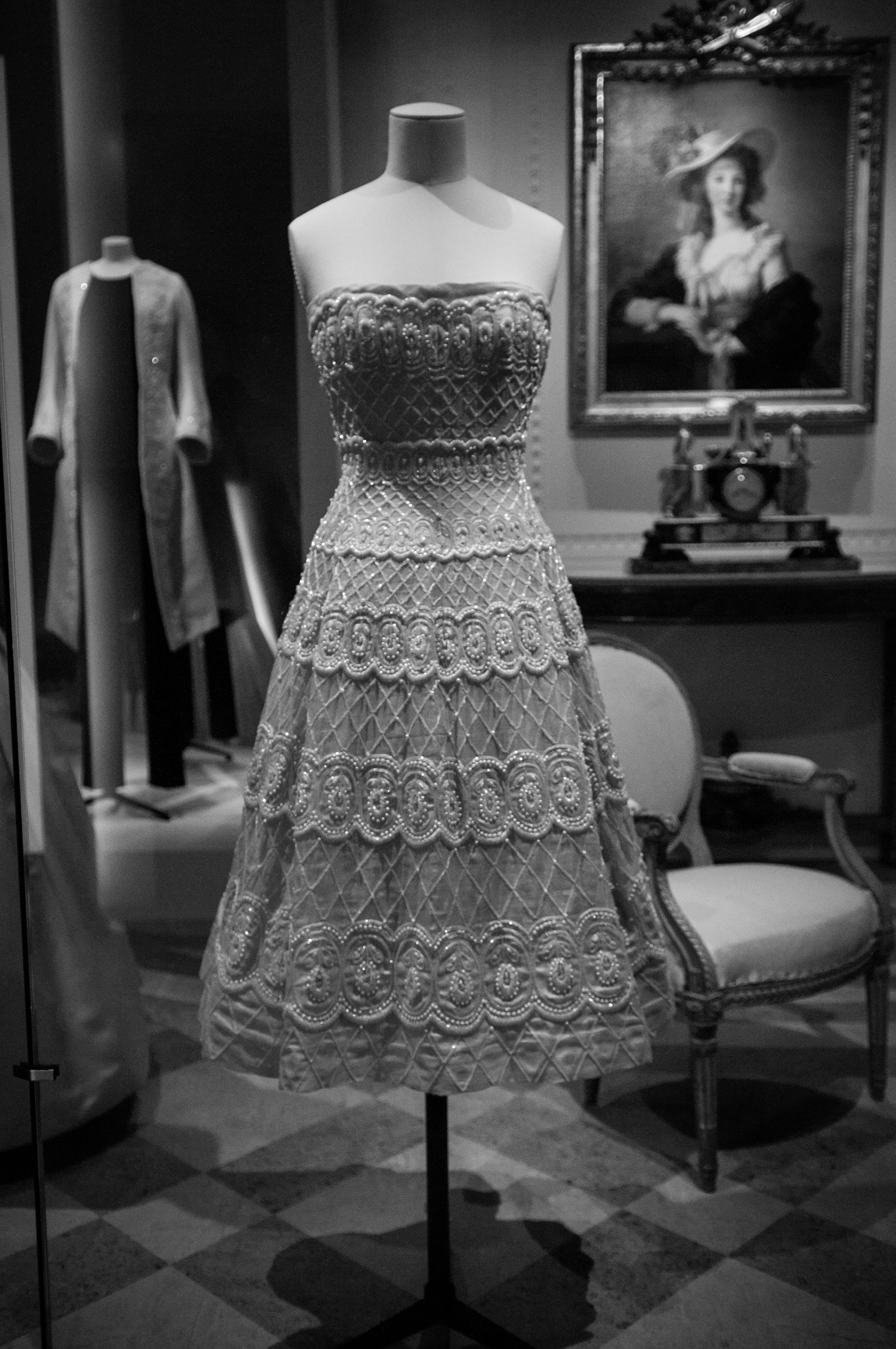
The New Look: Why Women Rioted Over a Dress in 1947
Christian Dior’s February 1947 collection used twenty yards of fabric per skirt at a moment when British women were rationed to two. The reaction was adoration, fury, and an industry rebuilt overnight.

Le Smoking: Yves Saint Laurent Dresses Women in Tuxedos
In August of 1966, an evening tuxedo appeared on a Paris runway. The model was a woman. The century shifted, quietly, on its heel.