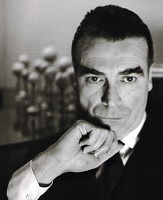
- 1895 (MDCCCXCV)
- 1972 (MCMLXXII)
- Basque Spanish
- Eisa, Balenciaga
- •The tunic dress (1955)
- •The sack dress (1957)
- •The one-seam coat
- •Couture as architecture
Cristóbal Balenciaga
The master. The Basque fisherman’s son who taught the postwar couture its structure, and whom Dior called "the couturier of us all."
Of the twentieth-century couturiers, Balenciaga is the technical. His contemporaries conceded this. Dior called him "the master of us all." Chanel, rarely generous, said he was "the only one among us who is truly a couturier." Both judgments were correct. More than anyone else of his generation, Balenciaga understood couture as architecture — as a structural problem in which fabric was the building material and the body the volume to be addressed.
He was born in 1895 in Getaria, a fishing village on the Basque coast. His father died when Cristóbal was eleven. His mother taught him to sew. The Marquesa de Casa Torres funded his apprenticeship and wore his first commissions. By 1917 he had opened an atelier in San Sebastián; the Spanish Civil War closed it. He arrived in Paris in 1937 and opened on the avenue George V the following August.
The Silhouette, Revised
Balenciaga's great decade was the 1950s, during which he revised — almost unilaterally — the postwar female silhouette. Where Dior had re-cinched the waist, Balenciaga progressively released it. The tunic dress of 1955, the sack dress of 1957, the baby-doll of 1958, the empire line of 1959: each moved the structural emphasis away from the waist. His women stood differently in his clothes because his clothes made them stand differently.
A woman has no need to be perfect or even beautiful to wear my dresses. The dress will do all that for her. — Cristóbal Balenciaga
Technique
Balenciaga cut his own toiles. He was, rare among couturiers, a finished tailor in every technique his atelier used. His one-seam coat of 1961 — a coat from a single piece of fabric with one structural seam up the back — is technically astonishing and the subject of several monographs.
Silence
He gave exactly one interview in his lifetime, to The Times of London, in 1971, the year before his death. His shows were held without music, without applause, in rooms lit at ordinary intensity. The dresses were presented and the viewer either understood them or did not.
He closed the house abruptly in May 1968, citing the student protests and the evident end of the couture order. "It's a dog's life," he told a colleague. He died in Javea, Spain, in 1972. The house was reopened in 1986; Nicolas Ghesquière ran it from 1997 to 2012; Demna has run it since 2015. Each revival has been a reading of the archive. The archive itself remains the standard against which postwar couture is measured.
Related Dispatches

Mod: How British Teenagers Killed Parisian Fashion in the 1960s
Carnaby Street, the Vespa, a geometric mini, a bob cut to the jawline. The youth-culture uprising that, for the first time in fashion history, dictated the terms to Paris.
The New Look: Why Women Rioted Over a Dress in 1947
Christian Dior’s February 1947 collection used twenty yards of fabric per skirt at a moment when British women were rationed to two. The reaction was adoration, fury, and an industry rebuilt overnight.
Le Smoking: Yves Saint Laurent Dresses Women in Tuxedos
In August of 1966, an evening tuxedo appeared on a Paris runway. The model was a woman. The century shifted, quietly, on its heel.